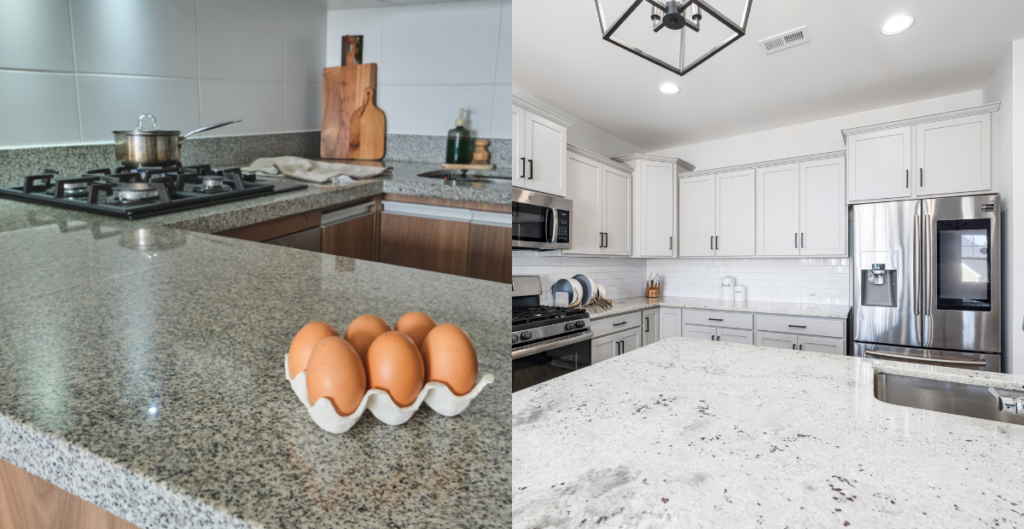
Countertops’ large surface makes them the focal point of the kitchen. They are used for chopping vegetables & placing food bowls. Countertops are low-maintenance and easy to clean.
Granite and Quartz are two popular countertop choices. Their durability and attractiveness make them ideal for kitchens.
According to Rachel Bogardus Drew, The Director of the Remodelling Futures Program at the Centre for Housing Studies of Harvard University. Home renovation costs can reach up to $524 billion in 2026.
However, renovating your kitchen doesn’t need to break your bank.
This article will give you a quick Granite vs Quartz Countertop Cost Comparison.
2. Granite
Granite is a rock made of magma. It is built slowly, underground, as magma cools down. It consists of feldspar, mica and quartz. Their presence gives granite its unique colours and patterns.
How Granite countertops are made.
The process of making a granite countertop is long and hard. The granite is imported from Brazil, Italy, India, and China. First, the granite is separated from the bedrock. Explosives are used to free the block. Then, massive diamond-coated saws are used to cut the raw blocks into slabs.
The slab is then polished several times until it gets the right finish. Finally, these slabs are transported to your home for installation.
Why Granite countertops are popular
Every granite slab is unique. The colours and patterns are the result of millions of years of geological processes. The concentration of feldspar, mica and quartz gives granite its unique veins.
Homeowners chose granite for its ability to withstand scratches, stains and heat. Its unique patterns and veins give the kitchen a timeless look. Granite also increases a home’s resale value.
3. Quartz
Quartz is an engineered stone. Made by crushing different stones and joining them together with polymer resin. Man-made quartz countertops are stronger and display consistent patterns.
How Quartz Countertops Are Made
Quartz minerals are crushed into a fine powder. They are then mixed with polymer resins and colour pigments. There is 93 % quartz & 7 % other materials. After mixing the items, the industrial mixer pours them into moulds. A machine then levels it and removes air from it. It is then placed into a high-heat kiln to harden. Finally, the slabs are taken out and transported to houses and showrooms.
Why Quartz Countertops Are Popular
Quartz countertops are popular for many reasons. It has a non-porous surface. The stains and spills are easy to wipe. It needs no maintenance.
4. Granite vs Quartz Countertop Cost Comparison: Overview
The price range in the US for granite and quartz is usually the same. A common misconception is that quartz costs less than granite because it is man-made.
Breton Stone Company was the only one that patented the quartz countertop development. It then revealed that knowledge to a few other companies. This limited the manufacturing of quartz while the demand kept increasing. Hence, making the prices soar.
The granite fabrication facilities kept opening in countries like Brazil and India. Lowering the cost of entry-level granite colours like Santa Cecilia, Black Pearl, and Coffee Brown.
Cost variation in different states
There are some granite deposits in U.S. states like Georgia, New Hampshire, Idaho & Massachusetts. But the majority of granite is imported from countries like China, India and Brazil.
The reason prices vary by state is that the local granite is available at are lower price. But the imported granite that is shipped from overseas carries extra costs, like the extraction cost, shipping cost, and taxes.
Cost variation by installer
Installers set their own prices based on their experience and skill. The total installation charges include cutting, fabrication, edge profiles, sealing, polishing and installation. Larger kitchens with complex layouts, multiple sinks, and cooktop cutouts cost more.
Cost variation due to slab thickness.
Slabs come in two sizes: 2 cm and 3 cm. The thicker the slab is, the more expensive it is. Thicker slabs offer more durability and need less support. Thinner slabs need to be reinforced with wood.
5. Granite vs Quartz Countertop Cost Comparison: Material Costs
Granite and quartz are priced mainly by the slab, but the reasons behind those prices differ. Slab costs are affected by:
- Stone origin, pattern, and thickness (granite)
- Brand, manufacturing process, and design complexity (quartz)
- Imported vs local slabs (shipping, taxes, handling)
- Special finishes like honed or leathered surfaces
Slab costs depend on the Stone origin, pattern variation and slab thickness. Common granite colours are usually more affordable. Exotic stones with dramatic veining or limited supply sit at the higher end of the price range.
Quartz slab costs are influenced by brand, manufacturing process, and design complexity. Consistent colours and simple patterns are cheaper. Premium designs that mimic natural marble or stone cost more.
Imported slabs cost more than local ones due to shipping, taxes, and handling. Rare colours and speciality finishes like honed or leathered raise the overall price.
6. Granite vs Quartz Countertop Cost Comparison: Installation Cost
Installation costs for granite and quartz countertops in the U.S. are often the same as the slabs. Installation costs are affected by.
- Cutting & fabrication
- Edge profiles
- Sealing & polishing
- Installation complexity
Labour rates vary by region. Skilled stone fabricators charge more in metropolitan areas and states. The complexity of the project also plays a major role. Straight runs with minimal cuts are less expensive. Kitchens with multiple corners, islands, or cutouts for sinks and cooktops cost more.
Cabinet preparation adds to the cost. Especially if cabinets are uneven or unable to support the weight of countertops. In some cases, reinforcement or levelling is required before installation begins.
Expenses such as old countertop removal, sink installation, & seam placement can quickly add up. Installation prices vary widely due to local labour markets and project difficulty.
7. Maintenance Costs
Costs can affect the long-term value of granite and quartz countertops. Maintenance is affected by:
- Sealing schedule
- Heat sensitivity
- Cracks, or Discolouration Repairs
Granite requires periodic sealing to protect it from stains and moisture. Homeowners may need to reseal granite every one to three years. A small but recurring maintenance cost over time. Daily care is simple, but spills should be cleaned quickly to prevent absorption.
Quartz, being non-porous, does not need sealing and is easier to maintain. Regular cleaning with mild soap and water keeps long-term upkeep costs low. On the downside, quartz is sensitive to high heat, and damage from hot pans may lead to costly repairs.
Both materials can last decades when properly cared for. Unexpected long-term expenses often include professional repairs for chips, cracks, or discolouration. Replacement costs if severe damage occurs.
8. Which One Is Cheaper?
Granite is often cheaper upfront. Standard granite slabs usually cost less than mid-range quartz. If homeowners choose common colours and simple edge profiles. For budget-focused renovations, granite can be the lower initial investment.
Quartz becomes more cost-effective over time for many households. Its low maintenance, no sealing requirements, and consistent durability reduce long-term expenses. For busy kitchens, these savings add up.
The “cheapest” option depends on how the kitchen is used. A low-use kitchen may favour granite’s lower purchase price. A high-traffic home saves more with quartz over the years.
9. Which Is Better for a Kitchen?
Choosing between granite and quartz for a kitchen depends on how the space is used. Both materials are strong. Quartz has a slight edge because its engineered structure makes it more resistant. It clearly performs better since it is non-porous and does not absorb liquids. Granite can stain if not properly sealed.
Heat resistance favours granite. It handles hot pots and pans better. Quartz is damaged by excessive heat due to the resins used in manufacturing. For kitchens with frequent spills and kids, quartz is the more practical choice.
Single households where cooking is occasional may prefer granite for its natural beauty. Ultimately, cooking habits and lifestyle should guide the decision more than price alone.
10. Final Verdict: Granite or Quartz?
There is no universal winner between granite and quartz. Only the right choice for the right homeowner. Granite offers a lower upfront cost, natural beauty, heat resistance, and unique patterns. Quartz provides easier maintenance, better stain resistance, and long-term convenience.
Granite is a good choice for homeowners who enjoy natural stone and do not mind periodic sealing. Quartz is better suited for busy households and families with children.
In the end, trends should matter less than personal priorities. Budget, cooking habits and maintenance time should guide the decision.
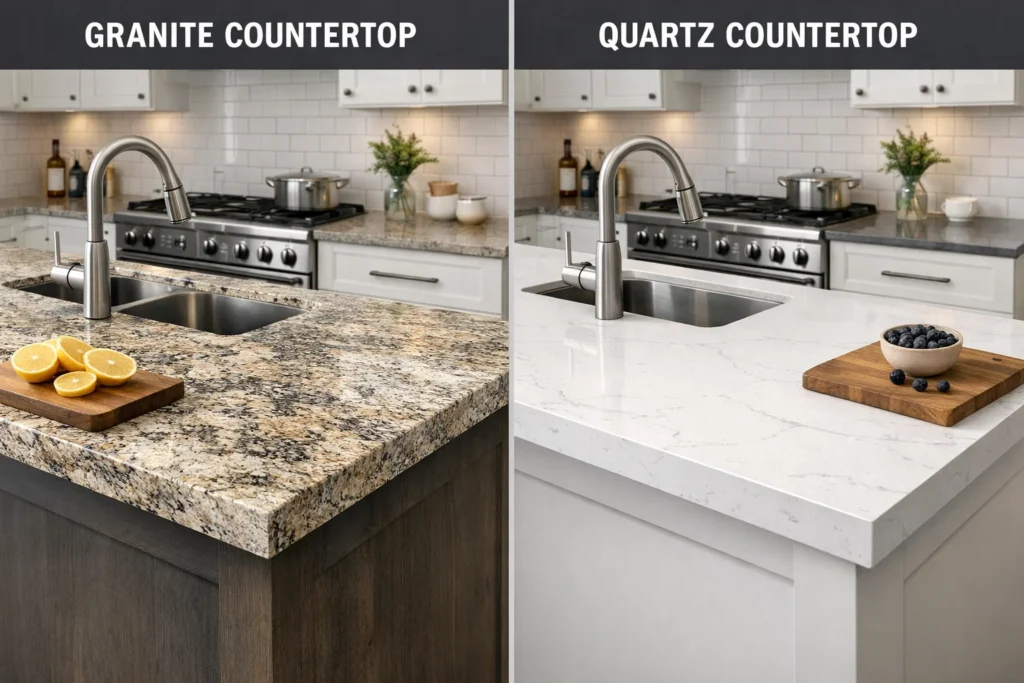
| Factor | Granite | Quartz |
| Upfront Cost | Usually cheaper, especially common colors | Higher initial cost |
| Maintenance | Requires sealing every 1–3 years | No sealing required |
| Durability | Very durable, handles heat well | Highly durable, more chip-resistant |
| Stain Resistance | Stains if not sealed properly | Excellent, non-porous surface |
| Heat Resistance | Strong heat resistance | Sensitive to high heat |
| Best For | Home chefs, natural stone lovers, budget-focused buyers | Busy families, low-maintenance households |
11. FAQs: Granite vs Quartz Countertops
1. Is granite cheaper than quartz in the U.S.?
Granite is often cheaper upfront, especially for common colors. Quartz usually costs more initially but can be more economical long-term due to lower maintenance.
2. Do granite countertops really need sealing?
Yes. Granite is porous and typically needs sealing every one to three years to prevent stains and moisture damage.
3. Are quartz countertops completely maintenance-free?
Quartz does not require sealing, but it still needs regular cleaning with mild soap. Avoid harsh chemicals and direct heat.
4. Which countertop lasts longer, granite or quartz?
Both can last decades when properly maintained. Longevity depends more on usage, installation quality, and care than the material itself.